
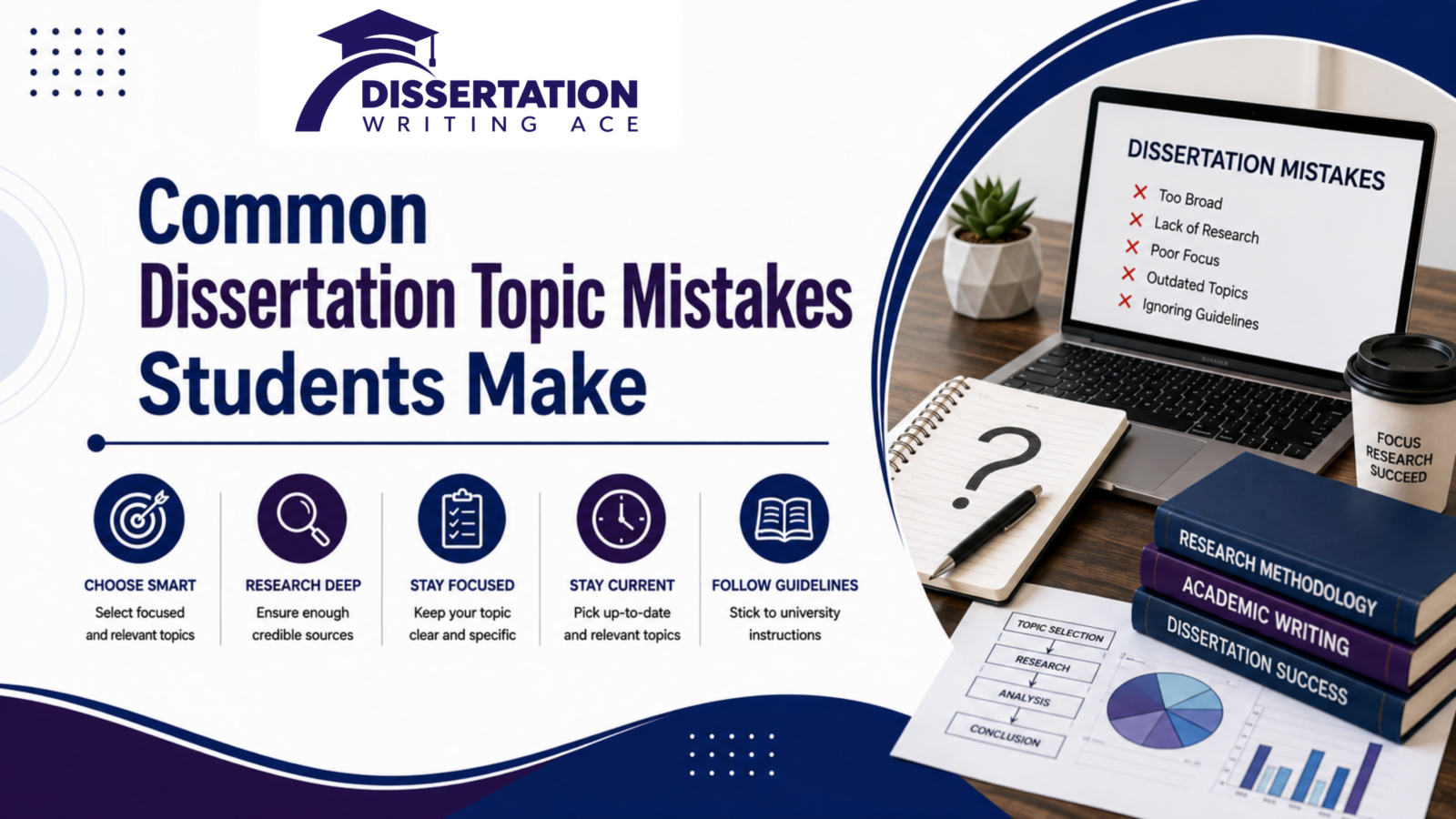
Nearly 30% of dissertation revisions trace back to a poorly defined topic chosen in the first few weeks. The dissertation revision statistics clearly show that early errors cause massive delays. Students often stumble right at the starting line. The pressure to pick a brilliant idea quickly often leads to very poor academic decisions.
This post closes our topic selection series by naming these errors directly. We present them in a simple list format so they are easy to check against. You can review your current ideas against these known pitfalls.
Our goal is to provide a scannable list for students to use before finalising their proposal. Identifying Dissertation Topic Mistakes early saves you months of stressful rewriting. Learning about the most common mistakes choosing a dissertation topic is an essential first step for every university student.
The 8 Most Common Dissertation Topic Mistakes
Here is a numbered list of frequent topic selection errors. Check your current idea against this guide.
Choosing a Topic That Is Too BroadSign:
A dissertation topic too broad cannot be summarised in two sentences without using the word “and”. The scope feels completely unmanageable.
Fix: Apply strict filters before committing to the project. You must learn how to narrow a broad research interest into a question effectively. Focus on a specific population or distinct time frame to reduce the scope.
Choosing a Topic That Is Too NarrowSign:
A dissertation topic too narrow returns almost nothing during a basic literature search. There is no scholarly conversation to join. Finding sources becomes impossible.
Fix: Widen one single filter at a time. Keep adjusting your search terms until a manageable body of literature appears online.
Picking a Topic Based on ConvenienceSign:
The topic was chosen because it seemed easy. It might just match a specific tutor specialism without sparking your genuine curiosity. This often leads to a severe supervisor topic mismatch later on.
Fix: Shortlist ideas from previous university modules that actually held your attention. Genuine passion sustains your writing effort.
Skipping the Preliminary Literature SearchSign:
You commit to an idea before checking whether it has been extensively covered already. You might also find it is barely covered at all.
Fix: Run a quick database search before finalising your paperwork. This is a quick pre-search rather than a full literature review. Finding a valid literature gap research area is an absolute requirement.
Ignoring Data and Access FeasibilitySign:
The project assumes access to a specific population or dataset that was never actually confirmed. The data might be blocked by expensive paywalls.
Fix: Name the exact data source before locking in the topic. Avoiding feasibility mistakes dissertation errors keeps your timeline incredibly safe.
Over-Personal or Advocacy TopicsSign:
The researcher is extremely personally invested in the subject. Objectivity becomes difficult and leads to a predetermined conclusion. This creates heavy advocacy research bias within the final paper.
Fix: Choose a subject close to your genuine interest. Ensure it is not so personal that your academic neutrality is completely compromised.
Underestimating Ethics Approval TimelinesSign:
The research involves vulnerable populations or highly sensitive data. The student did not factor in extended ethical review time.
Fix: Check institutional ethics turnaround times immediately. Consider using public secondary data if your writing timeline is very tight.
Treating Topic Choice as a One-Time DecisionSign:
The student refuses to revise the plan even after new information suggests it is failing. They stick to a broken plan stubbornly.
Fix: Treat topic selection as a highly iterative process. Early revision is completely normal and expected rather than a sign of failure.
Why These Mistakes Are So Costly Later
They Surface Late Not Early
Most early planning mistakes do not show up until the literature review stage. They also appear during the primary data collection phase. By this point weeks or even months of work have been completely lost.
You must learn how to check if your topic is researchable early in the academic year. Doing this prevents catastrophic discoveries in your final university term.
They Compound Rapidly
An overly broad idea often leads directly to a very weak thesis statement. This creates an entirely unfocused literature review chapter. Every subsequent chapter inherits the exact same lack of academic boundaries.
These core structural issues snowball quickly into unmanageable writing tasks. A broken foundation will eventually collapse the entire project.
How to Catch These Mistakes Before They Cost You Time
You can easily avoid dissertation topic mistakes with careful proactive planning. Review this simple checklist to protect your academic project:
- Run a quick literature search before finalising your university paperwork.
- State the topic as a single question naming the exact population and variable.
- Confirm your primary data access before committing to the research project.
- Bring a rough draft to your supervisor early rather than a highly polished one.
- Revisit the core idea at the proposal stage when it is still easily fixable.
Frequently Asked Questions
The most frequent error is picking an idea that is far too broad. This leads to an mountain of reading and a completely unfocused thesis. Learning how to choose a dissertation topic properly prevents this specific issue.
A topic is too broad if you cannot summarise it in one single sentence. It is too narrow if a database search returns zero related academic papers. To succeed You need a healthy balance.
Yes. Modifying your core idea during the early planning stages is completely normal. Iterative refining helps you build a much stronger final academic paper.
Yes. Extreme personal investment can severely compromise your academic neutrality. This often leads to predetermined conclusions and highly biased research methodologies.
You should verify primary data access before submitting your initial project proposal. Confirming availability immediately prevents massive common mistakes choosing a dissertation topic later in the year.
Conclusion
We have summarised the eight major Dissertation Topic Mistakes for you. You must run your initial idea through this checklist before locking in a final topic. This final step closes out our comprehensive choosing and scoping series.
Catching these critical errors in week one is highly beneficial. It is far cheaper than discovering them during the complex literature review phase. Early checks also save you from major issues after your official ethics submission.
Get your topic reviewed against these eight common mistakes before you commit. We offer professional dissertation proposal structure support to help you succeed.
Contact our expert team today to avoid dissertation topic mistakes entirely. Getting professional help early keeps your entire project safely on track.