
Educational engineering students may be uncertain whether the department requires a traditional chapter-based dissertation or a technical-report-style submission. The two approaches format the evidence differently and have different expectations regarding argument, analysis and presentation. Selecting the wrong engineering dissertation format may leave a powerful project out of shape with the departmental demands.
A clear engineering dissertation structure therefore starts with identifying which format applies before drafting begins. This guide compares the two methods, describes the typical parts in each, and explains how to determine what format your department wants.
Why Engineering Dissertations Don’t Follow One Standard Format
There is no single engineering dissertation format used by every university or department. In some programmes, students are expected to follow a traditional academic dissertation model, where the project is strongly research-driven. A technical-report style may or may not be acceptable in others since the project is more applied, experimental, design-oriented or related to professional engineering practice.
Some institutions may also permit a hybrid arrangement combining published or publishable papers with a shorter integrative report. For this reason, copying the structure of another university’s dissertation can be risky.
Check with the supervisor what he expects and the official departmental handbook before you write any paper. The format required helps make decisions regarding the sequence of chapters, the style of references, appendix or presentation of findings.
Traditional Dissertation Format
Typical Structure
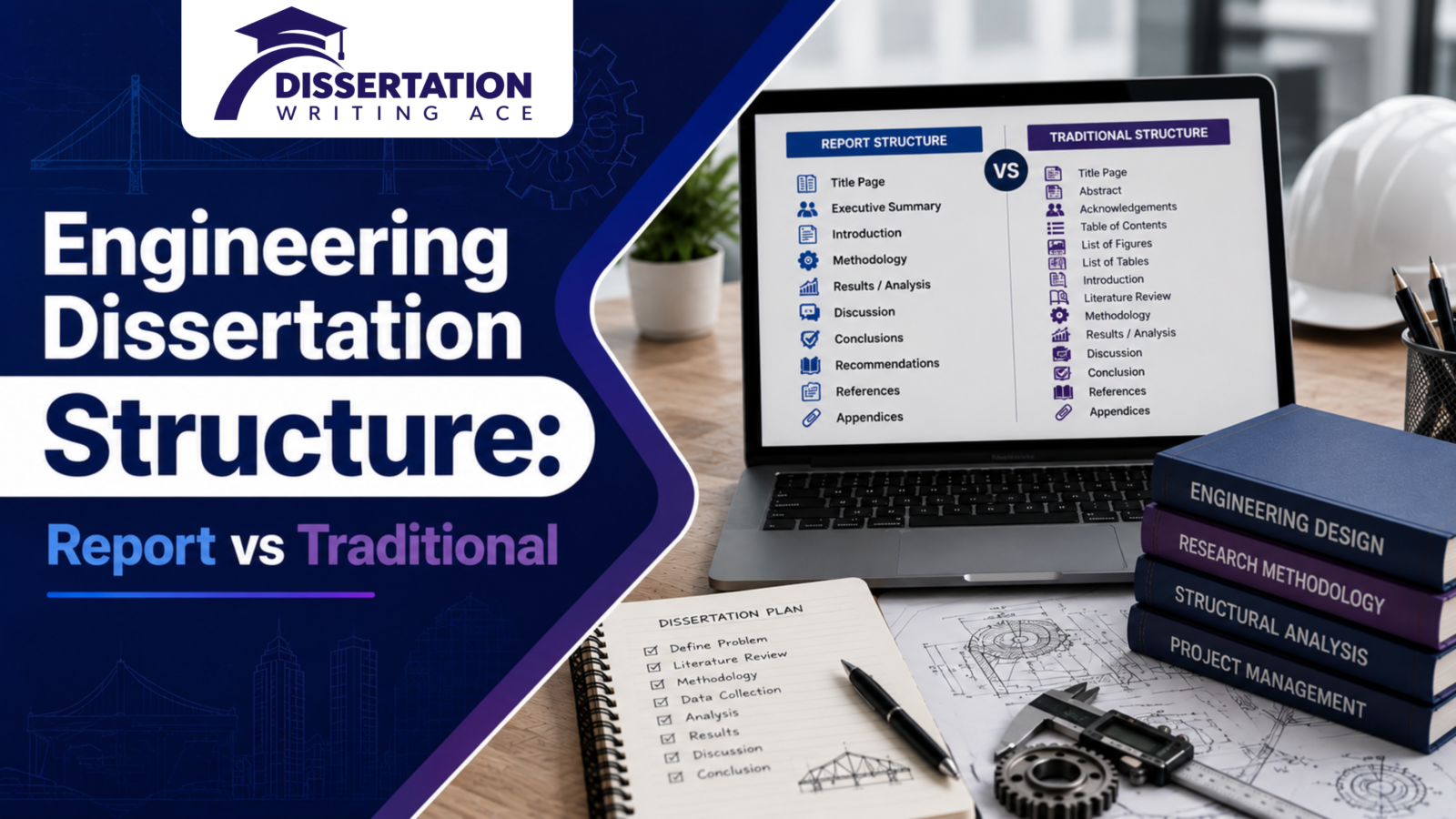
A traditional engineering thesis structure usually follows a chapter-based academic sequence:
- Title page
- Abstract
- Acknowledgements
- Introduction
- Literature review
- Methodology
- Results
- Discussion
- Conclusion
- References
- Appendices
The purpose is to build a connected academic argument. The introduction presents the problem and the central question of the research, and the literature review places the study in the background of the existing knowledge. In the research, the methodology is used to describe how the research was carried out, then giving a presentation and interpretation of the findings.
In this model, the engineering dissertation chapters are not simply separate containers for information. Each chapter contributes to the same research argument. The research gap should be justified by the literature review; the research question should be dealt with by the methodology and the discussion should relate the findings to the evidence and objectives presented in the literature review
This method is especially well-suited to projects where theoretical frameworking, critical dialogue on the literature, and a research-grounded argument are paramount to evaluation.
Technical Report Format
Typical Structure
A technical report structure is generally more concise and results-focused. The common order consists of the following.
- Title page
- Executive summary
- Table of contents
- Introduction
- Methodology
- Results
- Discussion
- Conclusion
- References
- Appendices
Although several engineering report sections resemble those in a traditional dissertation, their presentation may differ. A technical report tends to focus more on effective display of techniques, results, choice of design, or calculation, or experimental results. Supporting technical material may be placed in appendices so that the main report stays focused.
An opening summary is one of the observable differences. A classic dissertation typically has an abstract, but a technical report may have an executive summary which provides a more detailed view of the problem, its methodology, the results, and the conclusions.
Citation conventions may also differ. Traditional dissertations can be used by Harvard or APA depending on departmental rules, while engineering reports may use IEEE or ASME. Nonetheless, an IEEE format dissertation should only be utilized in instances where style is needed or allowed by the department or supervisor.
Technical Report vs Traditional Dissertation — Side-by-Side Comparison
Understanding engineering dissertation vs technical report requirements is easier when the two formats are compared directly.
| Aspect | Traditional Dissertation | Technical Report |
| Structure | Narrative chapters building an argument | Concise, results-focused sections |
| Opening Summary | Abstract, usually about half a page | Executive summary, often longer and more detailed |
| Citation Style | Harvard/APA, depending on department | IEEE/ASME, common in engineering |
| Best Suited For | Research-driven, theory-building projects | Applied, design, or experimental projects |
| Typical Length | Around 50-150+ pages | Often shorter and more data or appendix-heavy |
The important distinction is the purpose of the document. A traditional engineering dissertation structure generally gives more space to develop an academic argument across chapters. A technical report is more focused on clarity, technical evidence, results and professional communication. Neither is automatically better. The right format varies according to the project and departmental requirements.
How to Confirm Which Format Your Department Expects
If you are unsure how to structure an engineering dissertation, start with official guidance rather than assumptions. First and foremost is to refer to the dissertation or thesis formatting guide that is published by your own engineering school or department. Look for required headings, preliminary pages, referencing rules, word or page limits, appendix requirements, and any templates provided.
Second, ask your supervisor directly. The appropriate structure is project-dependent, and thus students within the same department may be appropriately recommended differently since one project might be theoretical and the other experimental or design-based. Third, review dissertations, which have been successfully completed in the last few years in your department. These may indicate the application of formal guidance. Be aware of the order of the chapters, the balance of literature and technical outcomes and appendices.
In case you require further explanation about what should be included in each section, the next step in planning is a dissertation chapter breakdown. It can assist you in making a transition between selecting the general format and determining what each part should include. Format decisions are also easier when the research direction is clear, so guidance on how to choose a dissertation topic you won’t regret can be useful earlier in the process.
Frequently Asked Questions
A traditional dissertation is organised around narrative chapters that build a central academic argument. A technical report is generally more concise and focused on methods, technical evidence, results, and practical reporting. The decision will be made based on the requirements of the department and type of project
There is no universal format across engineering departments. Some require a traditional dissertation, others accept a technical-report approach, and some allow hybrid formats. Check your department’s handbook and supervisor’s guidance.
Possibly, the choice should follow departmental rules. Some programmes specify one format, while others allow the supervisor and student to select the approach that best suits the project.
Not necessarily. IEEE is common in engineering, but departments may require Harvard, APA, ASME, or another style. IEEE format dissertation should not be adopted in cases that do not correspond to official guidance.
The length depends on the institution, level of the degree and the type of project. Traditional dissertations may fall within a broad range of 50-150+ pages, while technical reports are often shorter and may place substantial data or technical detail in appendices. Departmental requirements should take priority.
Conclusion
There is no single correct engineering dissertation structure for every engineering student. The correct method is determined by your department, type of project, and what your supervisor expects. A traditional dissertation is generally better suited to research-driven work that develops an academic argument across connected chapters, while a technical report structure is often more appropriate for applied, experimental, or design-focused work.
The best way to ensure this is by ensuring the required engineering dissertation format is followed prior to writing. Visit the official handbook, meet with your supervisor and talk about the structure and look through the recent successful work within the department. Once the overall format is clear, a dissertation chapter breakdown can help you plan each section in more detail. In case you require assistance with the layout or format of an engineering dissertation, the subject-specific advice may be to make sure the final document fits the project and departmental expectations.