
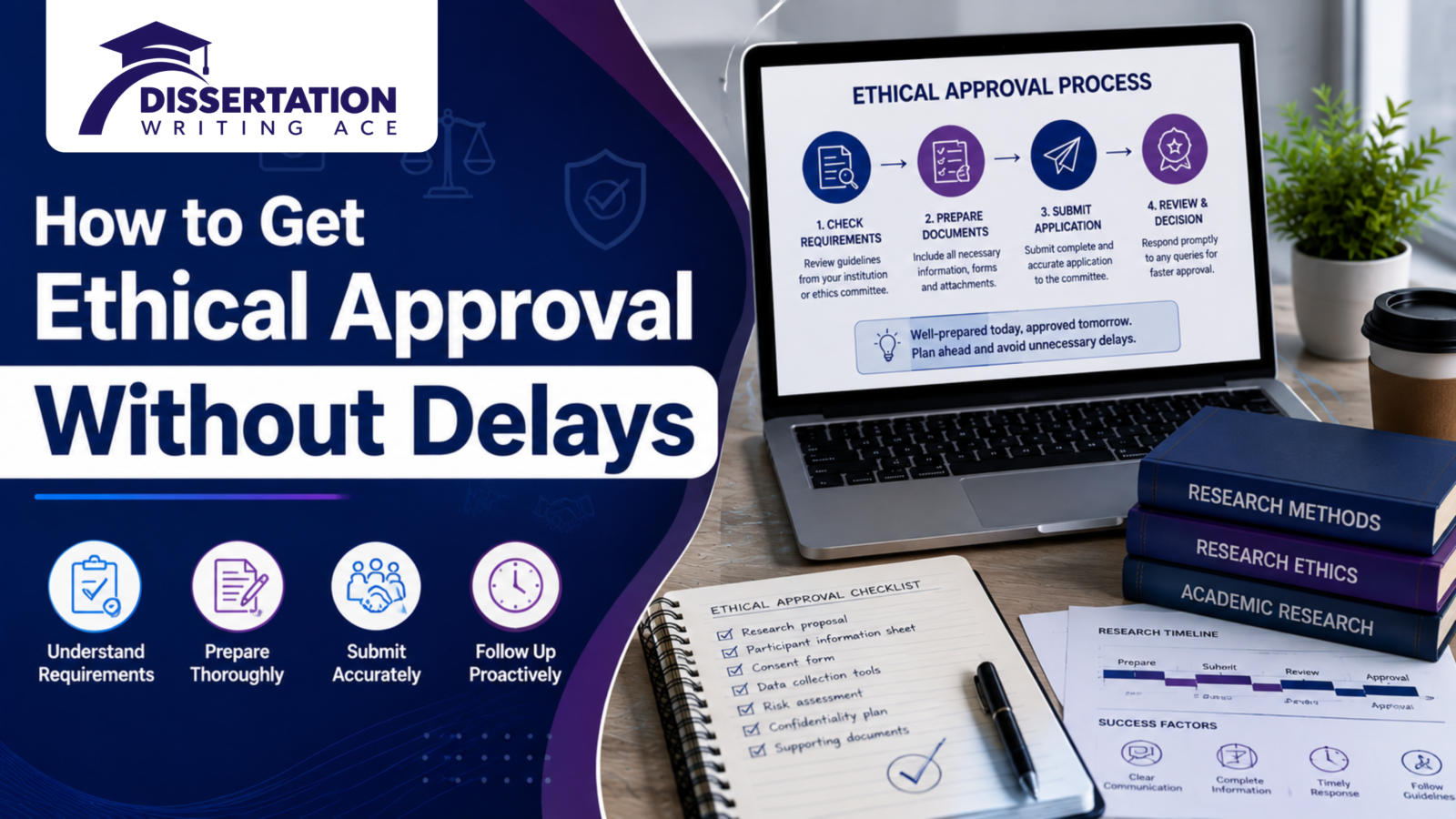
One of the most prevalent points where a dissertation timeline can slip is ethical approval. Students may have a great research question, a well-developed proposal and a clear deadline, only to find that their ethics application has been returned for revision because it is incomplete. This can slow down recruitment, data collection and, ultimately, submission.
The good news is that many delays are preventable. Knowing what an ethics reviewer needs to see and preparing your application accordingly can ensure that dissertation ethical approval is not a last-minute hurdle.
It will show you how to get ethics approval for dissertation research with practical procedures you can use regardless of which university’s ethics system or online application platform you’re using.
Why Ethical Approval Takes Longer Than Students Expect
Students often ask, “how long does ethical approval take?” There is no universal answer. The timescale depends on your institution, the type of research, the level of risk and whether your application needs review by a departmental or higher-level committee.
At some universities, low-risk applications may be reviewed relatively quickly. Other applications may take several weeks, particularly if they need discussion by a research ethics committee UK institutions use for more complex research.
Remember that an application sent back for changes is not the same as a rejected application. What is needed most is clarification, more documentation or a better description of the way the risks will be managed – not more review. But responding to those requests effectively restarts part of the approval process.
Research involving vulnerable participants, sensitive personal information, clinical settings, human tissue or organisations such as the NHS may require additional scrutiny. Where this is the case, students need to ensure they identify the correct approval route before submitting their university application.
And don’t expect that just because your project looks easy, you’ll have approval in a few days. This will depend on your university’s current guidance and supervisor, as well as the process and timescale involved.
The Most Common Causes of Delay
Understanding the reasons applications are returned is one of the most useful dissertation ethics application tips. Common problems include:
1. Missing Supporting Documents
An application may be difficult to assess if important documents are missing. Depending on your project, these could include an informed consent form, participant information sheet, recruitment materials, interview questions, questionnaires or a risk assessment.
2. An Underdeveloped Methodology
Ethics reviewers need sufficient methodological detail to comprehend what the participants will be subjected to and what risks might be involved. If your research design is still evolving, your ethics answers may be vague or may conflict with other parts of the application.
It is therefore generally preferable to develop the methodology first, and then complete the ethics application based on a consistent, finalised plan.
3. Underestimating Risk
Some students think that research is low risk, as it involves interviews or questionnaires. However, the ethical risk may vary depending on the subject matter, participant group, questions asked or information collected.
Research involving children, vulnerable adults, traumatic experiences, illegal activity, sensitive health information or potentially distressing topics may, for example, require additional safeguards.
4. Applying Too Close to the Deadline
Even a well-prepared application can take time to review. Committee meetings may operate on fixed schedules, and reviewers may request amendments.
If data collection is planned immediately after the expected approval date, even a minor revision can disrupt your dissertation schedule.
This is why avoiding ethics approval delays should begin with realistic project planning rather than trying to speed up the review after submission.
How to Get Approval Without Delays: A Step-by-Step Checklist
Step 1: Apply as Early as Possible
Once your methodology has developed enough that you can answer the questions correctly, start working on your ethics application.
You don’t have to have all of the words of your dissertation written, but you do have to know what you are going to study, who will be in your study, how you are going to recruit participants, what data you will collect and how you will protect participants.
Before planning your data collection dates, check your university’s deadlines and approval routes.
Step 2: Prepare All Supporting Documents in Advance
Create a document checklist before opening the ethics application.
Depending on your project, this could include:
- An informed consent form
- A participant information sheet
- Participant recruitment materials
- Interview or focus-group questions
- Surveys or questionnaires
- Risk assessments
- Data-management information
- Permission letters where required
- Debriefing information
Make sure the documents agree with the main application. For example, if the application says interviews will last 30 minutes but the participant information sheet says 60 minutes, reviewers may ask for clarification.
Step 3: Be Upfront About Risk
Don’t try to pretend that a project is a lower risk project by not including relevant info.
Instead, identify possible risks and how you will mitigate them. Where relevant, consider physical, psychological, social, legal, privacy and data security risks.
If your study involves vulnerable participants, sensitive topics or external organisations make this clear. Describe the safeguards you will use including informed consent procedures, confidentiality measures, withdrawal rights, secure data storage and appropriate referral procedures where applicable.
Being transparent makes it easier for reviewers to understand your research and to determine if the safeguards you propose are adequate.
Step 4: Use Your University’s Templates Exactly
If your university provides templates for an informed consent form, participant information sheet, risk assessment or ethics application, use them.
Templates are intended to gather information that reviewers often request. Your application may be returned to you if you change the format for no reason or do not complete required sections.
Before you submit, check to see if your department has any additional instructions to the central university guidance.
Step 5: Ask Your Supervisor to Review the Application
Your supervisor can often identify inconsistencies before the application reaches the committee.
Ask them to check whether:
- Your research methods are clearly explained.
- Participant risks have been identified.
- Recruitment procedures are realistic.
- Consent procedures are appropriate.
- Your informed consent form matches the study.
- Your participant information sheet contains consistent information.
- Confidentiality and data handling are clearly explained.
- Every required supporting document has been attached.
A final review can prevent avoidable amendments later.
Step 6: Build a Buffer into Your Dissertation Timeline
Do not treat your expected approval date as a guaranteed date.
Build additional time between ethics approval and the planned start of recruitment or data collection. This is especially important where your application could require revisions or additional institutional approval.
For planning purposes, connect your ethics deadline to the wider dissertation schedule. A sample dissertation proposal timeline can help you see where ethics review should sit alongside proposal development, methodology, recruitment, data collection, analysis and writing.
What Happens If Your Application Is Sent Back?
If an ethics application comes back for amendment, don’t assume that something has gone terribly wrong.
Read each reviewer comment carefully and respond to whatever is being asked for. Avoid making unrelated changes that could create inconsistencies elsewhere in the application.
Check the main application and all supporting documents for each amendment. If you change your recruitment process, e.g. make sure the participant information sheet and consent documentation still accurately describe what participants will experience.
If you’re not sure about a comment, ask your supervisor or the relevant university ethics contact instead of guessing.
Frequently Asked Questions
There is no single standard timescale. Approval may take several days or several weeks depending on your university, the review route and the complexity or risk level of your research. Check your institution’s current guidance and allow a buffer before data collection.
Requirements vary, but commonly requested documents include an informed consent form, participant information sheet, recruitment materials, research instruments, risk assessments and information about data management. Always follow your university’s specific checklist.
You must not undertake any research activity that requires ethical approval without first obtaining it. If you begin recruitment or data collection too early, this can create major problems for your project and may break university research requirements. When in doubt, ask your supervisor and follow the rules of your institution.
Normally you need to answer the reviewer’s comments and upload the necessary changes. Review each revised document for consistency prior to resubmission. Returning an application does not automatically mean that your research has been rejected.
Not necessarily. Requirements depend on the nature of the research, participants, data and institutional rules. Even projects that appear low-risk may need an ethics assessment or formal confirmation that full approval is not required. Check your university’s process rather than assuming your project is exempt
Conclusion
Most dissertation ethical approval delays are caused by issues that can be addressed before submission: incomplete documents, unclear methodology, inadequate risk information, inconsistent participant materials or poor timing.
The most effective approach is to treat ethics as part of your research planning rather than as an administrative task to complete at the end. Develop your methodology first, prepare every supporting document, identify risks honestly, follow your university’s templates and allow enough time for review and possible amendments.
Most importantly, avoid planning data collection around the earliest possible approval date. Use a realistic sample dissertation proposal timeline to build in a buffer between submitting your ethics application, receiving approval and beginning participant recruitment.
If you want additional reassurance before submission, having your ethics application, informed consent form, participant information sheet and supporting documents reviewed for clarity and consistency can help you identify avoidable issues before they reach the research ethics committee UK students submit to.
That preparation will not guarantee instant approval, but it can significantly reduce the risk of preventable delays and give your dissertation proposal structure a much more reliable foundation.