
Having a good research idea is not necessarily sufficient to receive approval of a dissertation proposal. Supervisors also want to show that the project is possible to be completed in a realistic way within the given period of time. Most proposals are sent back to be revisited due to vague, ambitious, or out-of-order research plans. An effective dissertation proposal timeline would resolve this issue by demonstrating when all significant tasks will have been accomplished and the relationships between one activity and another. A dissertation Gantt chart is a chart that transforms the visible process of a proposal into a schedule. It demonstrates that you have taken into account literature search, research design, ethics consent, feedback, and revising time.
Why Supervisors Expect a Timeline in Your Proposal
A realistic research proposal schedule illustrates that you are aware of what is required in research practically. Supervisors should be aware of what you are interested in researching, as well as whether the work could be completed in an orderly manner. A timeline gives a clear picture of the dissertation milestones that will see the project through topic development up to proposal revision.
It also makes task dependencies visible. Indicatively, ethical approval might take the form of ensuring that participant recruitment or data collection is not commenced before ethics approval is provided. Likewise, the research question should normally be focused before the methodology is finalised. Setting out these relationships in advance reduces the risk of unrealistic sequencing. The schedule also provides you and your supervisor with a common ground on which to review progress, rapid delays and adjustments.
Sample Dissertation Proposal Timeline
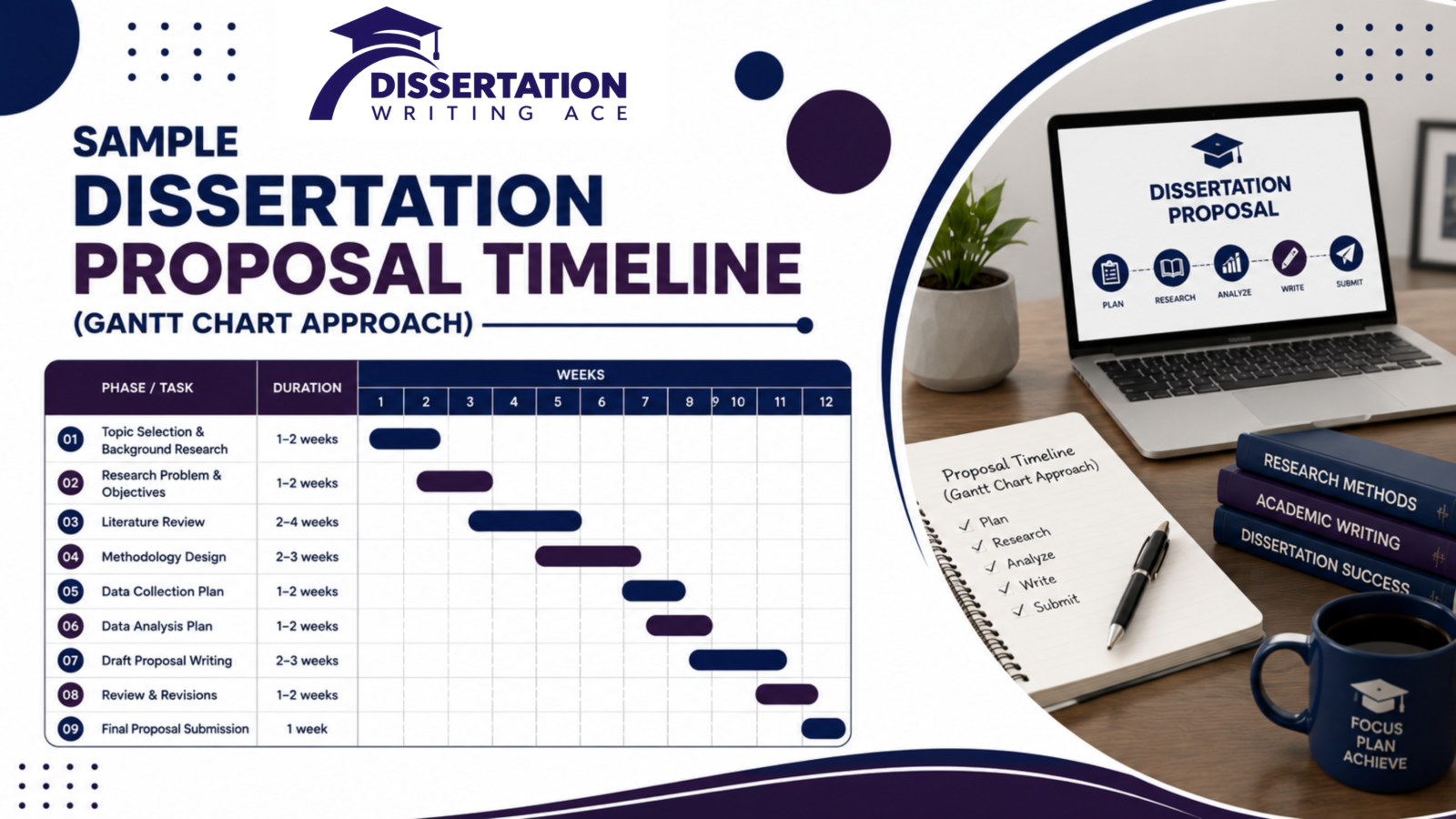
The following dissertation proposal timeline example uses a simple 14-week schedule. It is created as a flexible dissertation proposal Gantt chart that can be tailored to your university calendar, programme requirements, and availability of supervisors, ensuring the weeks can be modified to reflect this.
| Phase | Task | Suggested Timeframe |
| 1 | Topic selection & initial reading | Weeks 1-2 |
| 2 | Literature review | Weeks 36 |
| 3 | Research question & rationale | Weeks 6-7 |
| 4 | Methodology design | Weeks 7-9 |
| 5 | Ethics approval submission | Weeks 9-11 |
| 6 | Proposal writing & submission | Weeks 11-13 |
| 7 | Supervisor feedback & revisions | Weeks 13-14 |
Some stages overlap because dissertation planning is rarely linear. Primary reading can often be carried out as the literature review and research question and methodology can be refined as the project progresses. The primary reason is to provide every step with a certain position within the process but still leave it flexible. If your institution requires formal ethical approval before fieldwork, additional time may be needed for Phase 5.
How to Build Your Own Timeline, Step by Step
Step 1 — List Every Major Task
Break the proposal stage into separate activities rather than treating “write proposal” as one large task. An enhanced dissertation project plan identifies topic choice, preliminary reading, literature review, development of research questions, development of methodology, ethics preparation, drafting, submission, feedback and revision as different activities.
You might also get to use pilot testing or access negotiations time, or software preparation time or data-management planning time depending on your subject.
Step 2 — Identify Dependencies
Identify activities that are dependent on previous tasks. As an example, it is not often possible to start data collection before ethics requirements are met, and it is not always possible to completely justify a methodology until the research question is clear.
Dependence is one reason a dissertation Gantt chart is useful. Any delay in one stage may have implications for subsequent stages, and therefore using the mapping at the initial stages will give the schedule more credibility. Students preparing for ethics review should also read guidance on how to get ethical approval without delays before fixing final dates.
Step 3 — Assign Realistic Timeframes
The timeline should be good and not idealised. Allow enough time for tasks requiring repeated reading, drafting, or feedback, especially the literature review.
Make buffer time ahead of exam periods, holidays, supervisor response time, accessing difficulties or surprise revisions. Being aware of how to plan a dissertation timeline is not to plan all the tasks by the expected time to finish, as you know that some things may take longer than planned.
Step 4 — Choose Your Tool
Your dissertation timeline template does not need to be complicated. Excel or Google Sheets can include a basic, table-based chart with the weeks at the top and the tasks at the side. This can be easily edited and can be easily reviewed by supervisors.
To create a more visual representation, it is possible to use Tom’s Planner or TeamGantt to produce a formal Gantt chart.
Common Timeline Mistakes to Avoid
One common mistake is underestimating the literature review. Finding suitable research, evaluating it, comparing sources, and identifying a defensible gap often takes longer than expected.
Another mistake is failing to allow enough time for ethics approval. The approval processes may include revisions, requests for clarification or institutional deadlines. Unless your project includes subjects, sensitive information or entry to organisations, this step should not be a prompt administrative activity.
Students usually also leave no buffer to receive feedback from the supervisor. Most proposals get better with 1-or-more cycles of review and revision. When the dissertation project plan finishes at the time of submission with no time to make any alterations, it can seem unrealistic.
Lastly, do not consider writing in one block. It is easier to keep track of progress and lessen the time pressure at the end by dividing writing into smaller dissertation milestones.
Frequently Asked Questions
Not every university requires a formal chart, but a clear timeline is commonly expected because it shows that the project is feasible. When the guidelines require a schedule or project plan, research plan, or a timeline, a Gantt-style format is typically appropriate.
Some common activities include topic selection, reading, literature review, formulation of research questions, methodology design, ethics preparation, proposal drafting, submission, supervisor feedback, and revision.
There is no one right duration. This timeframe will be based on the programme, complexity of the project, ethics, access needs and institutional deadlines. The sample timeline puts forward a framework as opposed to a strict guideline.
You can use Excel, Google Sheets, Tom’s Planner, TeamGantt, or another project-management tool. For most proposals, readability matters more than advanced software.
A timeline is a planning tool, not a guarantee. Perhaps when you get behind you need to find out which tasks are impacted late in the project, redefine your schedule, and discuss significant changes with your supervisor. Buffer time makes adjustments easier.
Conclusion
A realistic dissertation proposal timeline strengthens your proposal because it shows that you have thought beyond the research idea and considered how the project will actually be delivered. A definite plan outlines the key milestones, indicates dependencies, provides your supervisor with practical dissertation milestones to monitor, and minimizes unnecessary delays. Use the sample above as a flexible dissertation timeline template rather than a fixed schedule. Adjust the phases to suit your subject, university requirements, and available time. If you are still planning the rest of your proposal, review a dissertation proposal structure guide so the timeline matches the content and order of the full document.
If you already have a draft timeline or proposal, a final review before submission can help identify unrealistic timeframes, missing stages, or sequencing problems before they are raised by your supervisor.